Tag: Tablets

  • Micromax Funbook P255 launched

    Micromax Funbook P255 launched

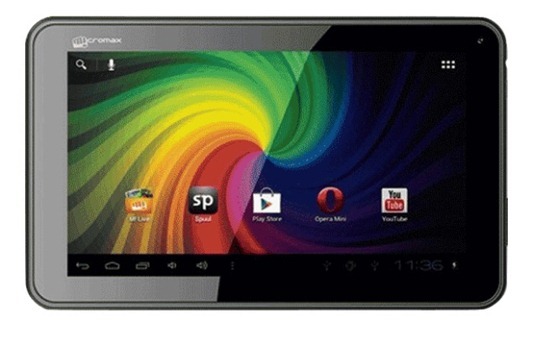
    funbook-p255-bigMicromax has no parallel when it comes to the frequency of phone launch. While sticking to launching one phone/ tablet every week, Micromax this week has launched an all new Funbook P255 tablet with 7 inch capacitative touchscreen.

    It is available on e-commerce portal infibeam.com for Rs. 4899.

    It runs on  Android v.4.0.4 Ice Cream Sandwich OS. It is powered by 1.2 GHz Cortex A8 processor. The screen displays the content in 800 x 480 pixels resolution. The tablet bears the latest slim design that looks elegant and comes in classic black color. The tablet sports Dual camera with a 2 MP camera in the rear and a 0.3 MP VGA camera in the front that can support online video chats.

    The Micromax Funbook P255 comes with a range of connectivity features like 3G, Wi-Fi connectivity, Wi-Fi Hotspot, and USB port. The user can also plug in 3G Dongle for using internet on the tablet.

    Apart from this, Micromax Bolt A40 is also available on mobile store. It is available on Infibeam for Rs 5,999. This phone has been based on the older Android version and is said to quite similar to one of its other phones.

    This Smartphones has been built on the Android 2.3.5 Gingerbread and is powered by a powerful 1GHz processor that lets experience a smoother UI. Now you get better upload and download speed. It makes multi-tasking easy for you. It has a Spreadtrum SC6820 Chipset.

    Micromax Funbook P255 Key Features

    •  Android v4.0.4 (Ice Cream Sandwich) OS
    •  0.3 MP Secondary Camera
    •  Wi-Fi Enabled
    •  2 MP Primary Camera
    •  1.2 GHz Cortex-A8 Processor
    •  7-inch Capacitive Touchscreen
    •  Expandable Storage Capacity of 32 GB

    Micromax Bolt A40 Key Features

    • Android 2.3.5 Gingerbread
    • 1GHz processor
    • 4.5inch TFT Touch Screen
    •  2MP rear camera and 0.3MP front camera
    • EDGE and GPS
    • Bluetooth and USB
    • 1500mAh battery    

  • MWC 2013: Asus Fonepad

    Asus announced the Fonepad on Monday at MWC along with its third generation Padfone, a 7in tablet that can make phone calls.

    Following its announcement, all were confused, and questioned whether a 7in tablet should double up as a smartphone.

    The first thing that struck us about the Fonepad was its design, in particular its similarities to the Nexus 7 tablet built by Asus. From the front, you’d be forgiven for confusing the Fonepad for Google’s tablet, since its glossy black bezel and dimensions are almost identical to those of the Nexus 7.

    However, when you flip the device over the Asus Fonepad starts to show its uniqueness.

    The Asus Fonepad runs Android 4.2 Jelly Bean

    Unlike the plasticky Nexus 7, the Fonepad features a metallic back panel, which will be made available in both silver and gold hues. Although it’s not quite as easy to grip as the textured back panel of the Google Nexus 7, it certainly delivers a more high-end feel, despite the tablet’s budget price tag. Not to mention it looks great, especially the silvery hued model.

    A 7in 1280×800 screen sits within this metallic casing, and for us this is one of the device’s highlights. The IPS screen technology that Asus has used means that the device offers excellent viewing angles, and text was legible even when we held the device under the bright MWC lights.

    Not only that, the 7in multitouch display also delivers extremely vivid colours, and despite the similar screen specifications it easily outperforms the Nexus 7 display.The Asus Fonepad features a metallic design

    The Asus Fonepad is quite responsive too, thanks to the 1.2GHz Intel Atom processor under the bonnet. It”s not a fancy quad-core chip, but it certainly offers an all-around slick and fluid experience.

    The latest version of Google’s mobile operating system, Android 4.2 Jelly Bean is onboard too, which Asus has supplemented with its own custom software shell. However, unlike the user interface that you’ll find on a Samsung or HTC device, Asus’ skin is very stripped back, a feature that should appeal to those who prefer a vanilla Android experience.

    The Asus Fonepad features a 7in 1280x800 HD screen

    Of course, the most quirky feature Asus has added to the device is its ability to make calls. Much like the Samsung Galaxy Note 8.0, you can make calls straight from the device – a feature that will confuse some, including us. However, when we used the Fonepad’s dialpad we immediately recognised the the thought process behind it. Sure, we wouldn’t walk around London with a 7in tablet pressed against our face, but the device boasts a built-in speakerphone and can be used with headphones.

    There’s also the ability to make video calls, thanks to the Fonepad’s front-facing camera. This has a 1.2MP sensor, and while it doesn’t produce high quality images, its good enough for video calling.

    That’s not all the Asus Fonepad has to offer. It also comes with 16GB of internal storage expandable to 32GB via microSD, alongside a large 4,270mAh battery.

  • MWC 2013: Asus announces Padfone Infinity combo tablet/phone

    After weeks of teasing their MWC announcements, Asus has officially unveiled the PadFone Infinity. The new phone/tablet combo comes with improved internals to make for a package that competes directly with other 2013 flagships and brings the unique PadFone experience to a high-end smartphone.

    The PadFone Infinity is two devices bundled into one. We will start with the good news. The Infinity ships with Android 4.2, so at least the software experience should be on par with the rest of flagships around. The display has grown from the 4.7-inch one in the PadFone 2 to a 5-inch Super IPS+ LCD, and the full HD tag means you get 441 pixels per inch. It matches the likes of the Xperia Z and HTC Butterfly and brings a 1080p resolution to the table.

    The Asus PadFone brings two full HD displays in one retail package

    The Asus PadFone brings two full HD displays in one retail package

    The PadFone Infinity’s tablet component, or what Asus calls the Infinity Station, retains the 10.1-inch screen, but there’s full HD resolution here too: it now has a resolution of 1920 x 1200 pixels, up from 1280 x 800 pixels in the last model.
    The Infinity’s insides have been upgraded too. It packs a quad-core Snapdragon 600 chip clocked at 1.7GHz and an Adreno 320 GPU, a combination that is gracing more and more flagships. The RAM has also been increased from 1GB to 2GB.
    Buyers can choose to get the 32GB or the 64GB version of the PadFone Infinity. However, there is no microSD card slot, which is an odd decision considering one could have been fitted into the PadFone’s tablet component without much issue.
    You get the usual connectivity options such as WiFi, Bluetooth 4.0, NFC, A-GPS and even GLONASS. The device uses a nano-SIM rather than micro-SIM.
    On the back, Asus has added a 13 megapixel auto-focus camera, an LED flash, a five-element f/2.0 lens and burst shooting at 8fps. The front-facing camera on both the tablet component and the phone is a 2 megapixel one. When docked, the PadFone uses the phone’s primary camera to take rear shots.
    Besides running Android 4.2 Jelly Bean, the PadFone Infinity comes with come Asus-exclusive apps. These include SuperNote for note taking, Story for creating a more immersive photo album and ASUS Echo for voice control.
    Battery life on the PadFone Infinity sounds promising. The 2,400mAh battery within the phone is good enough for about 10 hours of real-world use. The company claims the device can give you up to 19 hours of 3G talk time and 40 hours when docked into Infinity Station. The dock also has enough juice (5000 mAh) to fully recharge the docked PadFone Infinity up to three times, according to the company.
    Here are the key specifications of the PadFone Infinity:

    • 5-inch Super IPS+ full HD display (phone) and 10.1-inch display with 1920 x 1200 resolution (tablet)
    • 4G, LTE Cat3 up to 100Mbps DL, 3G, DC-HSPA+ up to 42Mbps, GSM, EDGE
    • Wi-Fi 802.11 a/ac/b/g/n, Wi-Fi Direct, dual-band, Wi-Fi hotspot
    • Bluetooth 4.0 with A2DP
    • GPS with A-GPS support and GLONASS
    • 13 megapixel primary camera with LED flash and 2 megapixel front camera
    • 32 or 64GB internal storage
    • MicroUSB 2.0 with MHL link and USB Host support

    And now for the bad news: the combined price of the Asus PadFone Infinity and the Infinity Station will be around £800 (approx Rs 65,000). The PadFone will arrive in Europe first, followed by Asia. Those looking to buy will have grey, gold and pink colour options to choose from.

  • MWC 2013: Lenovo introduces a trio of new Android tablets

    Following in the wake of Samsung’s and HP’s announcements yesterday, Lenovo has unveiled three new tablets to join the Android fray. These include a pair of 7-inch models, the A1000 and A3000, and a 10-inch slate, the S6000.


    Lenovo’s two 7-inch tablets and 10.1-inch tablet all run Google’s Android operating system and feature enhanced audio and dual-core or quad-core processors.

    The company is positioning the A1000 as “ideal for first-time tablet buyers,” which suggests a budget price point as does the dual-core processor. Lenovo says it has up to 16GB of internal capacity, which may mean there will be 8GB and 16GB versions, though the A1000 will come with a microSD card slot for additional storage. One premium feature is the inclusion of Dolby Digital Plus technology for improved audio performance.

    In comparison, the A3000 gets a quad-core MediaTek processor and a vague promise of ” extensive memory, ” though the IPS display only has a resolution of  1,024×600. You do get the option of 3G connectivity if you need to get online while away from a Wi-Fi connection.

    While the S6000 doesn’t have all of the top-end features of Google’s Nexus 10, it may turn out to be a lower-cost competitor. It will also make use of a quad-core MediaTek processor (the MTK 8389/8125), and the company promises a “substantial battery” in a 20-ounce package. Again, resolution on this IPS screen is not ultra-high res — 1,280×800 — but presumably the price tag is not ultra-high, either.

    lenovo-android-tablets-s6000-a1000-a3000

    “Lenovo’s latest Android tablet family is designed to meet the demands of a wide range of customers, particularly young, active users who are always on the go, and have adopted the 7-inch form factor as their own. With these latest additions to our tablet portfolio, we’ve created devices that address these customers’ needs, as well as devices for more demanding gamers and multimedia users,” Chen Wenhui, vice president and general manager of Lenovo’s mobile business unit, said in a statement. “We believe that our Android family of tablets will appeal to customers across the world as we’ve built our products to be highly accessible and flexible to serve multiple needs and budgets.”

    Unfortunately, Lenovo hasn’t disclosed the pricing on any of the three new tablets, though it says they will be released sometime in the second quarter of this year.