Intel has announced an array of new mobile processors and an LTE solution at the Mobile World Congress 2013 in Barcelona.
The new Atom processor platform, codenamed Clover Trail+, is designed for smartphones, with long battery life in mind. There are three initial 32 nanometer dual-core processors to choose from, the Z2580, the Z2560, and the Z2520, with speeds at 2.0 GHz, 1.6 GHz, and 1.2 GHZ respectively, which is up to double the computing speed of previous Atom processors.
With many rivals already jumping to quad-core, Intel will soon follow with the Atom Z2760 processor, codenamed Bay Trail, the company’s first quad-core SoC. Intel is teaming up with Compal, ECS, Pegatron, Quanta and Wistron to help bring this chip to the market, in addition to its previous partnership with top computer makers like Samsung, Acer, Asus, Dell, Lenovo, LG, HP, and others. It will be available around Christmas of this year.
“Today’s announcements build on Intel’s growing device portfolio across a range of mobile market segments,” Hermann Eul, vice president and co-general manager of Intel’s Mobile and Communications Group, said in a statement. “In less than a year’s time we have worked closely with our customers to bring Intel-based smartphones to market in more than 20 countries around the world, and have also delivered an industry-leading low-power Atom SoC tablet solution running Windows 8, and shipping with leading OEM customers today.”
Intel officials said the new Atom platform offers twice the performance and up to three times the graphics abilities of its “Medfield” predecessor, all in a low-power envelope. They said that Asus, Lenovo and ZTE are among the first OEMs to offer smartphones and tablets based on Clover Trail+. Lenovo at the MWC was showing off the K900 smartphone running on the new Atom platform.
The company is also jumping on the 4G LTE bandwagon with the unveiling of the XMM 7160 multimode-multiband LTE solution, which it claims is the smallest and lowest-power technology of its kind, making it ideal for smartphones, tablets and Ultrabooks. Its modem can support 15 LTE bands at the same time, more than any rival, and the RF architecture can run real time algorithms for envelope tracking and antenna tuning, which results in cost-efficient multiband configurations. This is due out in the first half of the year, in time for an expected major boom in 4G connectivity.
LG showcased its much hyped Optimus series devices, that we’ve known about for quite sometime now, at the Mobile World Congress. It reiterated the presence of the Optimus G and Vu series and officially debuted the F and LII series of smartphones that have been seen in the previous weeks gaining momentum to the MWC.
LG Optimus G series
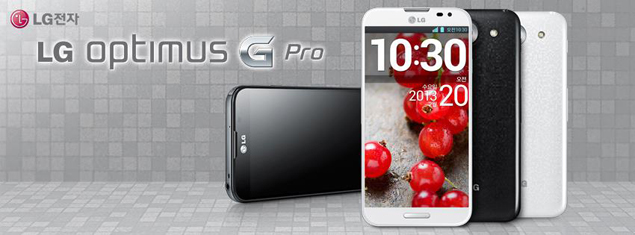
The company announced its latest flagship, the Optimus G Pro, which was recently launched in Japan and Korea both countries receiving different variants of the device. As expected both devices were spotted on the MWC floor.
To recap, the Korean version of the Optimus G Pro comes with a 5.5-inch 1080p full HD IPS display, a powerful 1.7GHz quad-core Qualcomm Snapdragon S4 Pro processor with 2GB RAM, Android 4.1.2 Jelly Bean, 3,140mAh battery, 13-megapixel rear shooter and a 2.1-megapixel front camera. The device features advanced UX features like dual-recording allowing users to shoot video from both the cameras simultaneously and Virtual Reality Panorama to capture panorama shots at 360 degree, QSlide, Live Zooming and QuickMemo.
The device features the typical LG glitter pattern on the back panel offering a "Digital Cube" effect, which is quite reminiscent of the Nexus 4. It sports a curved glass display that the company claims to give it a "2.5D" effect. The handset will be available in black and white colours and will pack a rather slim bezel.
This joins the company’s Optimus G that was originally launched in September last year. It is powered by 1.5GHz quad-core Snapdragon S4 Pro processor alongside 2GB of RAM. It includes a 4.7-inch 1280×768 (320ppi) display and sports a 13-megapixel rear camera and a 1.3-megapixel front shooter.
It comes with 32GB of built-in flash storage, but no microSD card slot or expandable storage of any kind. Connectivity options include Wi-Fi, Bluetooth, Micro-USB and NFC. The phone originally shipped with Android 4.0 Ice Cream Sandwich, but as per the listing on Saholic, in India, the phone will come with Android 4.1 Jelly Bean preloaded. The device is now available online in the country for Rs. 30, 990.
LG Optimus Vu Series
The LG Optimus Vu was launched in Korea and Japan in August last year and reached India two months later priced at Rs. 34,500. The 5-inch device simply made an appearance at MWC. It features TRUE-XGA IPS Display with a 1024×768 pixel revolution and a 4:3 aspect ratio.
Other specs include a 1.5GHz quad-core processor with 1GB RAM, Android 4.0.4, 32GB of internal storage and a 2,080mAh battery. The device also boasts a variety of connectivity options like Wi-Fi, 3G (HSPA+21 Mbps), Bluetooth 4.0, HDMI, DLNA, NFC, LTE and A-GPS. LG is also offering an NFC Tag(3) and a Rubbebdium Pen with the Optimus Vu.
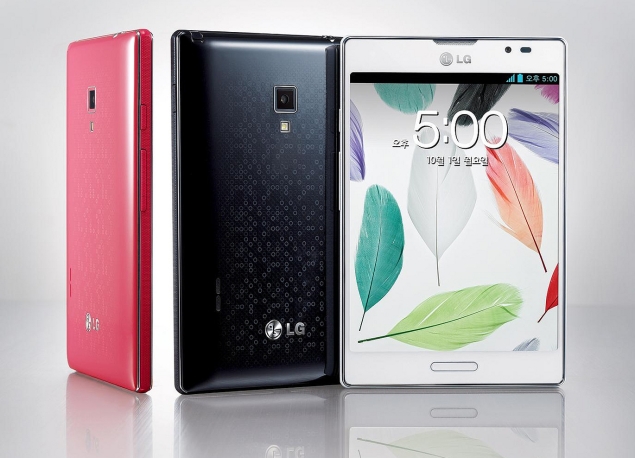
The successor to this device came in the form of the Vu II, with a Qualcomm 1.5Ghz dual-core processor on board with 2GB RAM, 3 GB of internal storage, an 8-megapixel autofocus rear shooter and a 1.3 megapixel front camera and a 2150mAh battery. It is available in three colour options – white, black and pink. The Pen of the Optimus Vu II has a slimmer nib, which LG feels will facilitate more accurate handwriting. Other features include Vu Talk and QRemote.
LG Optimus LII Series
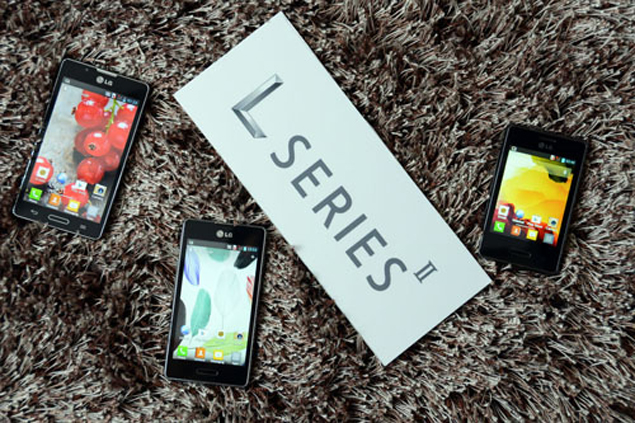
LG unveiled the next generation L Series II smartphones – the Optimus L3 II, Optimus L5 II and Optimus L7 II ahead of their official debut at MWC. The Korean manufacturer claims that it has built upon the widely successful L Series smartphones that sold more than 10 million units in the first 10 months, to include "contemporary design aesthetics and innovations that improve on the original".
In that regard, LG says it has introduced four new design elements incorporating a Seamless Layout, Laser Cut Contour, Radiant Rear Design and Smart LED Lighting on the home button.
The Optimus L7 II features a 4.3-inch IPS WVGA display, Android 4.1 Jelly Bean, 8-megapixel rear camera with LED flash, VGA front-facing camera, 1GHz dual-core Qualcomm MSM8225 processor with 768MB RAM, 4GB of internal storage and microSD card support. The handset measures 121.5 x 66.6 x 9.7 mm, and comes with a 2,460 mAh battery.
The Optimus L3 II with 3.2-inch QVGA IPS display and 1,540mAh battery Optimus L5 II has a larger 4-inch WVGA display and 1,700mAh battery.
The LII Series devices are said to be equipped with various proprietary features like QuickMemo, Quick Button and Safety Care.
QuickMemo allows users to capture and share handwritten ideas with a single tap, while Quick Button enables customers to personalize a hotkey to launch any app such as the camera, browser, music player or even QuickMemo. Safety Care offers three options – Emergency Call Forwarding, Phone Non-Usage Notice’ and My Location Notice – which can be programmed for emergency contacts.
LG Optimus F series
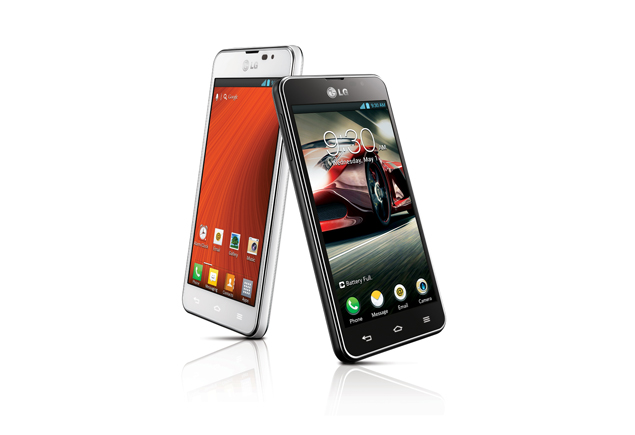
Earleir teased on LG’s Facebook page, the new F Series device feature the 4G LTE capable Optimus F5 and F7 smartphones. The device images were posted by notorious Twitter user @evleaks a week before the Barcelona event.
The Optimus F7 is said to feature a 4.7-inch True HD IPS (312ppi) display, a 1.5GHz dual-core processor, 2GB RAM, 8GB internal storage with a microSD slot for up to 32GB expansion, an 8-megapixel rear camera, 1.3-megapixel front camera and a 2,540mAH battery.
The Optimus F5 will sport a 4.3-inch IPS (256ppi) display, a 1.2GHz dual-core processor with 1GB RAM, 5-megapixel rear camera, 1.3-megapixel front camera, 8GB internal storage expandable upto 32GB via microSD and a 2,150mAH battery. Both the phones will feature Android 4.1.2 Jelly Bean and will have latest LG features like QSlide, QuickMemo, Live Zooming, QTranslator and Video Wiz amongst many others.
The company claims the handset’s LTE Category 4 modem offers download speeds of up to 150Mbps.
Networking and telecommunications equipment specialist Huawei Technologies introduced the Ascend P2, which the company claims is the world’s fastest smartphone with a 1.5GHz quad-core processor and Long Term Evolution (LTE) Category 4 technology, which provides download speeds of up to 150M bps.
The handset sports an infinity edge 4.7-inch high-definition in-cell touch display with second-generation Corning Gorilla Glass and will be available in black and white. The Ascend P2 will be on sale in France through network operator Orange in June 2013 and will also be available globally in the second quarter of 2013, the company said.
"We’re pleased to be working with Huawei again to enable our customers to have easier and faster access to all their favorite content," Yves Maitre, senior vice president of mobile multimedia and devices at Orange, said in a statement. "We are impressed by the design and look forward to putting the Ascend P2 into the hands of consumers as soon as possible."
The Emotion UI is also preinstalled with a smartphone housekeeper function to support real-time data-traffic tracking, automatic blacklisting and blocking, periodical system cleaning, and spontaneous exiting of idle programs and cache cleanup. The device also features antivirus, energy saving, privacy protection, software management and other functions.
The company claimed its proprietary swift sharing technology supports uploads and downloads two to three times faster than other smartphones in a WiFi environment, while its near-field communication (NFC) module enables e-payments and can act as an electronic ticket. In addition, Huawei’s Quick Power Control (QPC) and Automated Discontinuous Reception (ADRX) power-saving technologies reduce power consumption and charging time.
Other features include a 13-megapixel rear-facing camera with high dynamic range (HDR), and a 1.3MP front-facing camera for self-portrait and video shooting. A dedicated camera key on the side of the phone also allows instant access to picture taking, with one click for the camera to be activated and another time to take the shot. With Huawei’s camera algorithm, high-definition images can be captured even in backlit conditions, and the camera also features auto-adjustment modes.
The touch-screen, just 8.4mm slim, offers a "magic touch" feature that provides enhanced screen responsiveness, even when the user is wearing gloves.
Additionally, instant keyword translation and Wikipedia searches can now be done on a single window with the company’s "smart reading" technology. The screen also calibrates its brightness automatically under a variety of light conditions.
Following in the wake of Samsung’s and HP’s announcements yesterday, Lenovo has unveiled three new tablets to join the Android fray. These include a pair of 7-inch models, the A1000 and A3000, and a 10-inch slate, the S6000.
Lenovo’s two 7-inch tablets and 10.1-inch tablet all run Google’s Android operating system and feature enhanced audio and dual-core or quad-core processors.
The company is positioning the A1000 as “ideal for first-time tablet buyers,” which suggests a budget price point as does the dual-core processor. Lenovo says it has up to 16GB of internal capacity, which may mean there will be 8GB and 16GB versions, though the A1000 will come with a microSD card slot for additional storage. One premium feature is the inclusion of Dolby Digital Plus technology for improved audio performance.
In comparison, the A3000 gets a quad-core MediaTek processor and a vague promise of ” extensive memory, ” though the IPS display only has a resolution of 1,024×600. You do get the option of 3G connectivity if you need to get online while away from a Wi-Fi connection.
While the S6000 doesn’t have all of the top-end features of Google’s Nexus 10, it may turn out to be a lower-cost competitor. It will also make use of a quad-core MediaTek processor (the MTK 8389/8125), and the company promises a “substantial battery” in a 20-ounce package. Again, resolution on this IPS screen is not ultra-high res — 1,280×800 — but presumably the price tag is not ultra-high, either.
“Lenovo’s latest Android tablet family is designed to meet the demands of a wide range of customers, particularly young, active users who are always on the go, and have adopted the 7-inch form factor as their own. With these latest additions to our tablet portfolio, we’ve created devices that address these customers’ needs, as well as devices for more demanding gamers and multimedia users,” Chen Wenhui, vice president and general manager of Lenovo’s mobile business unit, said in a statement. “We believe that our Android family of tablets will appeal to customers across the world as we’ve built our products to be highly accessible and flexible to serve multiple needs and budgets.”
Unfortunately, Lenovo hasn’t disclosed the pricing on any of the three new tablets, though it says they will be released sometime in the second quarter of this year.
Samsung has surprised everyone at MWC in Barcelona by unveiling an eight-inch version of its stylus-equipped Galaxy Note tablet.
The new tablet is more than a smaller version of the Samsung Galaxy Note 10.1; there’s an uprated specification, and Samsung has also improved how the Note’s built-in stylus works. In Europe the Note 8 will have built-in 3G.
The Note 8 has a 1.6GHz quad-core processor, up from the 1.4GHz model in the Galaxy Note 10.1. As you’d expect, it’s significantly lighter, at 335g compared to 597g, so won’t be as much of a strain to carry around.
As with the Note 10.1, the Note 8’s S-Pen stylus is more than just a dumb pointing device. There are several stylus-specific functions built into the tablet’s Android 4.1 OS, such as pressure-sensitivity and windows that pop up over whatever app you’re currently using to help you take a quick note. Unlike on the Note 10.1, you can now use the S-Pen to tap the back and menu buttons under the Note 8’s screen.
The Note 8 also improved on the Note 10.1’s Multiscreen support, where two apps sit side-by-side, so you can watch a YouTube video while taking notes, for example. While the larger tablet only supported Multiscreen in six apps, there are now 20 apps that can sit side by side. It’s a big step towards making a tablet as useful as a laptop for certain tasks.
There are no great surprises behind the Note 8’s display. It’s a 1,280×800-pixel model, which gives it a pixel density of 189ppi. This is nothing spectacular, but is slightly more than the iPad Mini’s 163ppi.
The built-in 3G is a bonus for European users, especially for city dwellers with easy access to fast HSDPA networks. It also means it’s possible to use the Note 8 as a phone, but we’d recommend using a headset of some description rather than holding it to your head.
We liked the Galaxy Note 10.1’s stylus, but thought the tablet was overpriced compared to the competition. The Galaxy Note 8 is a useful smaller version, but, with no pricing information yet available, it remains to be seen whether Samsung will charge a large premium over the benchmark for tablets at this size: Google’s £159 Nexus 7.